
What Salt Air Does to a Cape Cod House
Salt air does not eat a house the way people imagine. It does three specific things, and once you can see them separately the maintenance stops being guesswork. It keeps surfaces damp for longer, because airborne salt is hygroscopic and holds moisture against the wall. It corrodes metal, which means the fasteners and the flashings age faster than the cladding they hold up. And it arrives on wind, which drives rain sideways into joints that would shed water anywhere inland. Cedar shingles going silver is the part everyone notices. It is also the least important of the three.
Why cedar goes silver, and why one wall goes first
Weathering on cedar is a surface event. Ultraviolet light breaks down the lignin that binds the wood fibres, rain washes the degraded material away, and what is left is a thin grey layer of cellulose over sound wood underneath. On a well-detailed wall it is a finish, not a failure, and it is the look most people buy a shingled Cape house for in the first place.
What varies is how it gets there, and that is why elevations diverge. A wall in full sun with good air movement dries fast and weathers to an even silver. A shaded north wall stays damp longer, and damp cedar grows mildew, so it goes dark and blotchy rather than silver — the colour difference between two walls of the same house is usually a moisture difference, not a material one.
The south-west elevation is the one that ages first on this Cape, and it earns that honestly. It takes the most sun, and the prevailing summer wind comes off the water from the same direction, so it also takes the most driven rain. Wetting and drying is what degrades a surface, and that wall does more cycles of it in a year than any other. It is the elevation to inspect first and the one that comes due for attention before the rest of the house looks ready.
The fasteners and the flashings are what actually fail
Here is the part that separates a coastal exterior from an inland one. The shingles will outlast the nails if you use the wrong nails. Plain and electro-galvanised steel corrodes in salt air, and cedar makes it worse — the natural tannins in the wood are acidic and attack the wrong metals. The visible result is a dark streak running down from every nail head, and the invisible one is a fastener losing its section until a wind event takes a course of shingles off.
The trade answer is stainless, ring-shank, for cedar in a coastal exposure. Hot-dipped galvanised is the compromise people reach for; it lasts longer than plain steel and it is still not stainless. It is a small line on a siding quote and one of the very few places where a cheaper decision is guaranteed to cost more later.
Galvanic corrosion is the second trap: put two dissimilar metals in contact with moisture between them and the less noble one corrodes fast. Aluminium against copper is the classic. Copper nails into aluminium flashing, an aluminium drip edge under a copper valley, a steel fastener through a copper gutter — all of them fail at the junction rather than in the middle, which makes them easy to miss on an inspection.
And then flashing, which is where most wall rot on this Cape actually starts. Step flashing at every roof-to-wall junction, head flashing over every window and door, and kickout flashing where a roof edge meets a wall and the water has to be thrown clear of the cladding. The kickout is the piece most often missing. Without it, every rainfall on that roof plane runs down the wall behind the shingles, into the sheathing, and the first sign is a soft spot in the framing years later.
Paint and stain fail in a pattern you can read
Coatings on a coastal wall fail in ways that tell you what went wrong, so it is worth learning the difference before you accept a diagnosis.
Film-forming paint blisters and peels when moisture pushes from behind. The paint is not the problem; the water getting into the wood and then trying to escape through a sealed surface is. On cedar that usually means it was applied to a wall that was not dry, or the backs and edges of the shingles were never primed, or there is no way for the wall to drain and breathe.
Penetrating stain does not blister. It fades and erodes, which means the failure mode is a re-coat rather than a strip-and-start-again. That is a real argument for stain over paint on an exposed elevation, and it is the reason the maintenance interval on a stained wall is shorter but each event is far cheaper.
Three other patterns worth telling apart. Black spotting that wipes off is mildew, a moisture problem. Brown streaking below knots is tannin bleed, normal on new cedar and usually a priming question. Fine dark streaks running straight down from nail heads is rust, and that one is not cosmetic — it means the fasteners are corroding and the wall has a clock on it.
Driven rain is not the same as rain
Rain falls down; driven rain does not. Wind pushes water sideways and upwards, past the overlap of a shingle course, over the top of a drip edge, and behind anything that was detailed on the assumption that water only travels one way. Every horizontal joint on a Cape exterior is a place where water gets in, and no amount of sealant changes that for long.
Which is why a coastal wall should be built to drain rather than to seal. A drainage gap behind the cladding — a rain screen — gives the water that does get in somewhere to go and lets the back of the shingle dry. Add a properly lapped weather-resistive barrier behind it and a way out at the bottom, and the wall stops depending on a perfect surface.
On a re-side this is the decision that matters most, and it is invisible once the job is done. Two siding quotes that look identical can differ by an entire wall assembly. Ask what goes behind the shingles and how water leaves the wall — the answer is more predictive of how the job ages than the grade of cedar on the front.
The state building code carries wind and coastal provisions that apply on this peninsula and they are stricter here than inland. What your specific address is subject to is a question for the Building Division, since the requirement follows the mapped exposure rather than the town line.
What maintenance actually prevents
Rinse the salt off the exposed elevations. Plain water, low pressure, once or twice a year. It sounds trivial and it is the single highest-return thing anybody does to a coastal exterior, because salt left on a surface keeps it damp between rainfalls.
Keep planting off the wall. A hydrangea against cedar holds moisture there permanently, and that wall will rot while the rest of the house is fine. Eighteen inches of air is enough.
Keep gutters clear and watch where the water lands. A blocked gutter does not just overflow; it concentrates a whole roof plane onto one strip of siding, and that strip fails years before its neighbours.
Re-coat on the product's schedule, not on the wall's appearance. By the time a stained wall looks obviously due, the surface has already been unprotected through a season. And replace a failed kickout or a lifted step flashing immediately — that repair costs almost nothing on the day and it is the difference between a flashing job and a framing job.
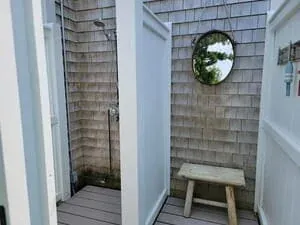
An outdoor shower deserves a separate mention, because it is a genuinely Cape fixture that pours water down one wall every day for four months. They are worth having and they need the detailing of a wet room, not of a fence: a drained base, a proper barrier behind the cladding, stainless fixings, and a look under the boards every couple of years.
Questions people actually ask
- Why does only one side of my house look bad?
Almost always exposure rather than materials. The south-west elevation takes the most sun and the most driven rain here, so it does far more wetting and drying cycles in a year than the others. A shaded north wall has the opposite problem — it stays damp, so it grows mildew and darkens instead of silvering. Same shingles, same installer, completely different rate of ageing.
- How often should a Cape house be re-stained?
The honest answer is that the exposed elevations and the sheltered ones will not come due at the same time, so a single interval for the whole house wastes money on one side and runs the other too long. Go by the surface and the product’s own schedule rather than the calendar, and expect the south-west wall to need attention noticeably sooner than the rest.
- Should I paint my cedar shingles or let them weather?
Letting them weather is the lowest-maintenance option and it is what most shingled Cape houses do. If you want colour, a penetrating stain is generally kinder to cedar in a coastal exposure than a film-forming paint: stain fades and erodes, so it re-coats, while paint blisters and peels when moisture pushes from behind and then has to be stripped. Painted cedar on an exposed wall is a long-term commitment.
- What is a kickout flashing and why does it matter so much?
It is a small piece of flashing at the point where a roof edge meets a wall, angled to throw water clear of the cladding instead of letting it run down behind it. It is frequently left out. When it is missing, every rainfall on that roof plane drains into the wall, and the damage shows up years later as rotten sheathing and framing rather than as a stain on a ceiling.
- Do I really need to wash the salt off?
It is the cheapest maintenance available on a coastal house. Airborne salt holds moisture against the surface between rainfalls, which keeps cedar damp, feeds mildew and accelerates corrosion on fasteners and fittings. A low-pressure rinse with plain water on the exposed elevations once or twice a year costs an afternoon and measurably slows everything described on this page.
Where to check this yourself
The work this guide is about
- Roofing and siding
Roofing and siding on Cape Cod from a Centerville contractor: salt air, driven rain, cedar exposure, ice dams on dormers, and storm damage handled honestly.
- Painting
Exterior painting on Cape Cod and interior work through the winter: preparation, moisture, the real spring and autumn windows, and the lead rule on older houses.
- Decks
Deck building on Cape Cod, where salt air decides the hardware: fasteners and hangers, decking material, guard and stair code, and the Barnstable permit.
The other guides
- How to Check a Contractor’s Licence in Massachusetts
The difference between a Construction Supervisor Licence and an HIC registration, what the Guaranty Fund pays, and the ten-minute check you can run before you sign anything.
- What a Building Permit Looks Like in Barnstable
The real sequence for a Barnstable homeowner — the Building Division, the other desks your project has to pass, and why the licensed supervisor applies rather than you.
- When to Schedule a Cape Cod Remodel
A month-by-month look at when work actually happens on the Cape, and how to work backwards from the date you want the house ready.
- Looking After a Cape Cod House You Do Not Live In
Around a third of Cape Cod housing sits empty for most of the year. What that does to a building, and what looking after one properly involves.
- How a Cape Cod Remodel Is Priced
No price list. An honest explanation of what moves the number on a Cape house, and how to read a quote so two of them can be compared.
Tell us what the house needs
Call and describe the job. If it is something we do, you will get a straight answer about how it works and what happens next. If it is not, we will say so.