
Flooring and Tile Installation
We install flooring and tile across Cape Cod - hardwood and engineered plank, tile floors, tiled showers and backsplashes. Almost everything that decides whether a floor still looks right in five years happens before the first board or the first tile goes down. The material is the easy decision. The substrate underneath it and the humidity around it are the ones that matter.
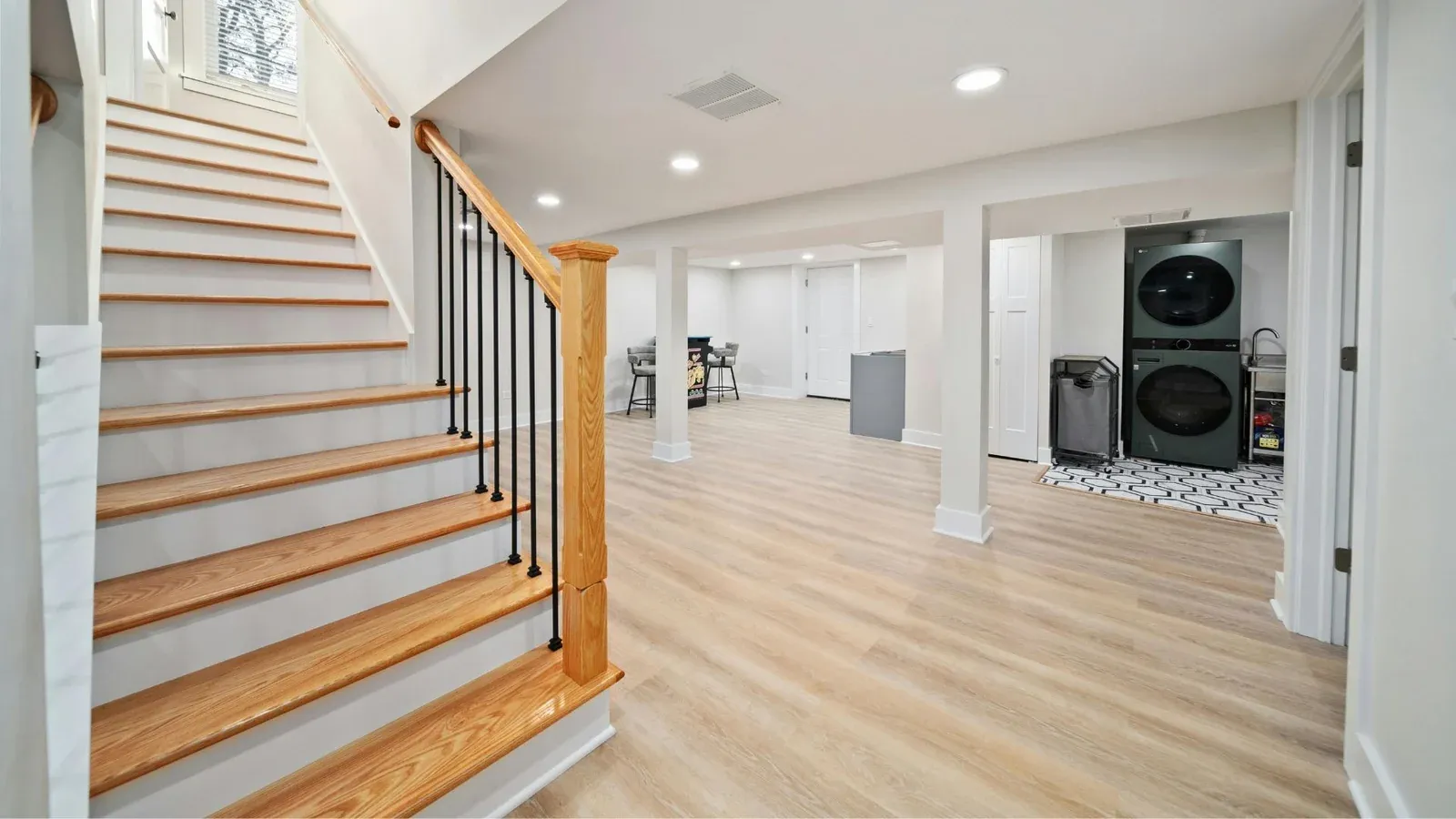
Wide plank or engineered, in a house that swings with the season
Solid wood moves. It takes on moisture in a humid July and gives it back in a dry heated January, and it does nearly all of that movement across the width of a board rather than along its length. That is why one floor can be tight in August and show fine lines between boards in February. It is normal, and it is proportional to width: a seven-inch plank moves more than twice as much at each joint as a three-inch strip in the same house.
Engineered plank is a genuine wood wear layer over a plywood or composite core, and the core is the part that does not move. In a Cape house with big seasonal swings - especially one that is not conditioned all year - engineered is frequently the more sensible floor, and the visible surface is the same species with the same finish. The trade-off is the wear layer. A thick one can be sanded and refinished more than once; a thin one cannot be sanded at all.
Put plainly: if you want eight-inch boards in a house that goes from a shut-up damp summer to a dry heated winter, engineered gets you the look with a fraction of the movement. If you want a floor three generations can sand, solid is still solid - keep the boards narrower and control the humidity.
A house that goes cold in January moves differently
This is the part that catches second-home owners out. A house heated to sixty-eight all winter has reasonably stable indoor humidity, and a wood floor in it settles into a narrow range. A house that is shut down and left at fifty does something else: it stays cold and damp right through the winter, then gets heated hard on the weekend the owners come back. Wood that sat at a high moisture content for months gives it up quickly, and boards shrink, cup, or cup and then split at the edges.
Two fixes, both cheap. Keep the house at a low steady heat rather than off, so the interior does not sit damp for months. And if the house genuinely goes unheated, say so before the floor is selected, because it changes the recommendation - engineered rather than solid, a moderate board width rather than the widest available, and sometimes a floating or fully bonded installation rather than nail-down.
It changes the timing too. Fitting solid wood in August, when the boards are as wet as they will ever be, and then heating that house hard in December gives you the widest gaps you will ever see in it. Installing into a heated house in the shoulder season lands the floor much closer to the average it has to live at.
Acclimation is not a formality
Wood gets delivered and left in the room it is going into, in the conditions it is going to live in, with the heating or cooling running as it normally would, until its moisture content matches the house. We meter it. We do not count days, because days are not the measurement - three days in a cold unheated house is not acclimation, it is storage.
New plaster, fresh drywall compound, a new slab and a basement that has just been dried out all put water into a building. Wood goes in after the wet trades have finished and the house has dried out, not alongside them. Getting that order wrong is the most common reason a new floor cups within its first year, and it is a scheduling problem rather than a materials one.
Under the tile: stiffness, flatness and crack isolation
Tile is brittle and does not bend. Everything under it has to be flat, stiff and stable, and anything that moves underneath eventually shows as a crack running in a straight line across the room. Half of a tile job is the layer nobody will ever see.
Stiffness is deflection - how much the floor flexes between joists under load. Tile needs a stiffer floor than carpet or wood does, and natural stone needs stiffer again. In an older Cape house with undersized or long-span joists, that sometimes means sistering joists or adding a layer of plywood before tile is even discussed. A beautiful tile floor over a bouncy structure is a cracked tile floor with a date on it.
Flatness is a separate property from level, and large-format tile is unforgiving about it. A floor out by half an inch over ten feet is invisible under carpet and impossible under a large tile, which cannot follow a hump the way a small one can. That gets fixed with a self-levelling compound or a floated bed, never with a thicker bed of adhesive under one corner.
Then isolation. An uncoupling or crack-isolation membrane over a concrete slab lets the substrate move slightly without dragging the tile with it, and over a slab with an existing crack it is not an upgrade, it is the only reason the tile survives. Movement joints matter as well - a soft joint where tile meets a wall, at every change of plane, and at intervals across a large floor. Grout is not a movement joint. Grout is what cracks when the movement joint was left out.
What our installation covers, and what tear-out finds
Our number covers removing the existing floor, preparing the substrate we can see, the installation itself, transitions and thresholds, and putting the trim back. What it cannot cover in advance is what is underneath the old floor, because nobody can see through it, and anyone who prices that sight-unseen is either padding it or planning to come back to you later.
The common finds, roughly in order of how often we hit them: a soft patch of subfloor under a dishwasher, a refrigerator water line or a toilet, which are the three places that leak slowly for years without anybody knowing. A layer of old quarter-inch underlayment that has to come up. Two or three previous floors stacked on each other, which is usually why the doors were cut short. A cracked slab. Joists notched or drilled through for a plumbing run at some point in the house's life.
We show you the opening before it gets covered, price the repair when we find it, and we do not lay a floor over a wet subfloor to protect a schedule. If tearing out a floor in a pre-1978 house means pulling painted baseboard and casing, that is work covered by the EPA's Renovation, Repair and Painting rule; old sheet flooring and its mastic get tested rather than guessed at.
Thresholds, stairs and the places floors actually wear out
Floors rarely fail in the middle of a room. They fail at the edges: the doorway to a bathroom where wet feet land, the slider where sand comes in, the top riser of a staircase that takes every single footfall, the transition between two materials of different thickness that somebody bridged with a strip that was never properly fixed down.
On the Cape, sand is the abrasive that ends a floor early. A hard, fully cured finish, a genuine mat inside and outside every exterior door, and tile rather than wood in the rooms that take beach traffic will do more for a floor's life than any upgrade in the wood itself. Sand is a mineral being walked across a finish, and no coating wins that argument indefinitely.
Stairs are their own piece of work. Retrofitting treads to an existing staircase is carpentry rather than flooring - nosings, returns on the open side and risers all have to be cut to the stair that exists, and no stair in an old house is square. It is worth pricing separately from the floor it connects, because it is a different day's work with a different skill behind it.

Questions people actually ask
- Can you install a new floor over the existing one?
Sometimes, and the decision is usually about height rather than adhesion. Every added layer raises the floor, which affects door bottoms, thresholds, the gap under a dishwasher and the top step of a staircase. Tile over a sound, well-bonded existing tile floor is possible with the right preparation. Laying over cushioned vinyl, or over anything that sounds hollow when you tap it, is not. We check for movement and hollow spots before recommending it.
- Will a wide-plank floor gap in the winter?
A little, and that is wood doing what wood does - shrinking across its width when the heating dries the house out, then closing up again in summer. Wider boards show it more. You reduce it by metering the material to the house before installation rather than counting days, by keeping the house at a steady low heat rather than switching it off, and by choosing engineered plank if the house goes cold and damp all winter.
- Can you tile over a cracked concrete slab?
Yes, provided the crack is not moving vertically or still widening, which we check first. A stable shrinkage crack is bridged with an uncoupling or crack-isolation membrane, which lets the slab move slightly without transferring that movement into the tile. A crack with a height difference across it, or one that is still opening, is a structural question and has to be answered before any tile is bonded to that slab.
- Do you repair the subfloor as well, or only install the finish floor?
We repair it. Tear-out is when subfloor damage actually gets discovered, so it is part of the job rather than a separate trade - soft spots around old leaks, delaminated panels, a joist notched out for plumbing years ago. We show you what is under there before it gets covered up and price the repair at that point, because it is not something anybody can quote honestly through an existing floor.
Where to check this yourself
Related work
- Kitchens
Kitchen remodeling in Hyannis, Centerville and across Cape Cod. The real order of work, why cabinet lead times set the schedule, and the off-season window.
- Bathrooms
Bathroom remodeling in Hyannis and across Cape Cod - waterproofing behind the tile, shower pans, ventilation, and the leak nobody is home to notice.
- Basement finishing
Basement finishing in Centerville and across Cape Cod. The high water table, drainage before framing, ceiling height, and egress for a basement bedroom.
Tell us what the house needs
Call and describe the job. If it is something we do, you will get a straight answer about how it works and what happens next. If it is not, we will say so.